
Office Trends
Hybrid Work Life: A Clash of Both Worlds
In a new report from Google Workspace, hybrid work means anything between full in-person work with limited time flexibility and full remote work with complete time flexibility.
Keeping in touch with colleagues while simultaneously working remotely can be trouble in some cases that may include Internet lagging, a decrease in networking between senior colleagues and newcomers, and a negative impact on mental health. Corporate worlds have been discussing whether remote work or all-in-person is better. Obviously, there’s a flip side to every coin. According to two new polls, businesses are gradually transitioning to hybrid. New research from Google Workspace and Kaspersky uncovers a plethora of inconsistencies in how individuals perceive hybrid work. A sizable number of employees prefer remote work, but another fraction is concerned about how to network in such an environment.
“Remote work appears to have improved my physical, social, and emotional well-being as an individual, but it has been affecting my relationship with the organization,” said Prasad Setty, vice president of digital work experience at Google Workspace.
For some employees, the trade-off is beneficial, according to the data by Kaspersky’s research, which found that 61% of employees do not feel secluded while working remotely. In addition, 37% of respondents stated communication with coworkers is better now than it was before the outbreak.
According to Setty, the poll found that just a tiny fraction of people are expected to be fully in the office or completely remote.
“75% expect hybrid to be the default option for us and the complications in the responses demonstrate people’s point of view and personal preferences,” he said.
The new task for leaders is to devise a collaboration tech stack that complements that balancing stack. Collaboration tools must be usable by all workers in all contexts. It’s a balancing act that necessitates fresh managerial abilities and a willingness to try new things. In 2022, there will be an aim to a balance between flexibility and efficiency for remote workers and networking and team development in person.
Here are some ideas from both reports that can be used to develop a hybrid plan for 2022.
The Formula to a Successful Hybrid
Views have altered to the point that the office is no longer the general place to perform work According to Google Workspace’s research, “Making hybrid work human”. The researchers cite the following explanations for this shift:
- Some remote work experiments will bear fruit.
- Setting up the technologies in-home office is more convenient now.
- The public’s perception of remote work has been positively accepted.
There are three benefits of working in a flexible workspace. The top three benefits are an increase in productivity, good well-being, and alternative ways of working. On the other hand, the top two downsides of working from home, according to those who struggled with it, were productivity and welfare.
Several survey findings reflected this sense of disconnection:
- 62% percent are concerned about their future job possibilities as a result of fewer opportunities to network and create relationships with senior leaders.
- 57% of respondents reported feeling detached from their workplace and colleagues.
- 53% reported that lack of interactions have caused an impact on their mental health
The study was carried out by Economist Impact researchers and was sponsored by Google Workspace. There were 1,244 survey respondents from North America, Europe, APAC, and Latin America, representing more than 15 industries and both small and large enterprises. As stated in the report, hybrid work is defined as any combination of full in-person employment with limited time flexibility and full-time remote work with complete time flexibility.
Making Collaborative Tools Suitable for Hybrid Work
Based on the poll, according to Setty, demonstrates the necessity for collaborative tools and hybrid work arrangements to achieve these three criteria:
1) Work is no longer linked to a particular spot.
2) Time management is essential.
3) Autonomy, flexibility, and human connection are all required.
Google Workspace’s Companion Mode, considers hybrid settings, as having some participants in a conference room and others virtually joining.
“Participants in a conference room can use hand raises, make remarks, and participate in polls without interfering with everyone else through companion mode,” he explained.
Setty believes that defining clear targets and critical results on a quarterly basis is the key to success when introducing flexible work hours.
“That way, everyone knows who is going to do what and when the team will meet to go through everything,” he explained.
To adapt from the shift work to remote work with ease, Setty said he reduced his weekly, 90-minute staff meeting to two 30-minute sessions in order to have more opportunities to check in with his team.
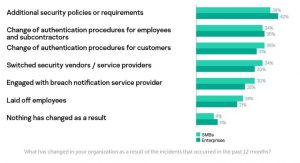
A survey by Kaspersky found that companies are using a variety of tactics to boost cybersecurity as many people continue to work from home.
A new survey found that most employees have successfully adapted to remote work. According to Kaspersky’s poll of 4,303, IT workers from 31 countries found that 61% of employees do not feel alone while working remotely. In addition, 37% of remote workers claimed they are communicating with their coworkers even better now. Nonetheless, a significant proportion — 39% of them feel secluded while working from home.
Based on the survey:
- 54% percent of employees reported an increase in workload as a result of remote work.
- 61% of employees reported no difference in communication with their teams while working remotely.
- 80% of businesses have attempted to address employee burnout, while 45% have developed solutions that genuinely help to reduce workload.
- 42% of SMBs and 43% of businesses have encountered IT security breaches.
- 45% prefer not to publicly report disclosures of confidential employee info.
People continue to utilize non-corporate devices and services for everything from email to resource planning software to web-conferencing platforms, despite the fact that use of each of these services has increased by only approximately 3% in the last year. Respondents to the survey also mentioned the following security concerns about working remotely:
- One of the most significant challenges, according to 42% of respondents, is a lack of end-user security culture.
- 42% of firms have come across inappropriate usage of IT resources by employees.
- 38% of businesses reported unauthorized data sharing via mobile devices.
In the report companies, Andrey Evdokimov, Kaspersky’s head of information security stated that firms must evaluate the worth of the information as well as the number of people who have access to it, in addition to precautionary measures.
“Breach of incidents are more prone to occur in businesses where a significant number of workers handle classified info that can be sold or used in some way. Change business operations if necessary, by lowering the number of people who have access to essential data, reducing the amount of data available to all employees, and making available information less enticing for theft (, eliminating the last digits of a credit card number, anonymizing data and so on).” As said by Evdokimov.